
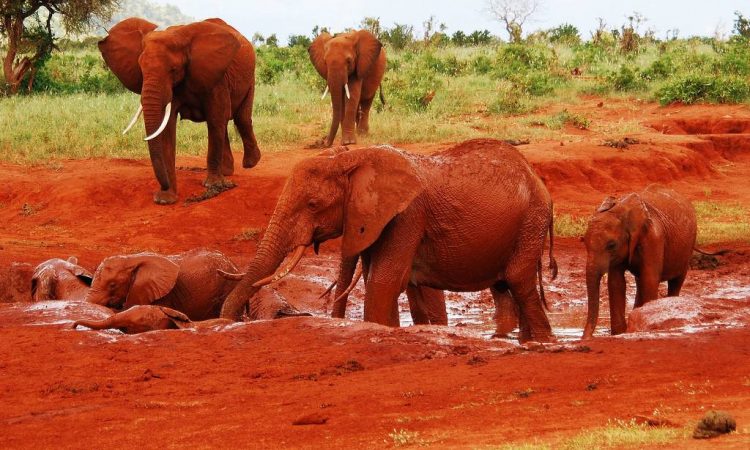
Tsavo East National Park, nicknamed the “Theatre of the Wild,” is one of Kenya’s most iconic safari destinations and the country’s largest national park. Covering approximately 13,747 square kilometres, Tsavo East is famous for its vast semi-arid wilderness, spectacular landscapes, abundant wildlife and, above all, its enormous herds of dust-red elephants.
The elephants of Tsavo are among the most memorable sights on a Tsavo East National Park safari. They are often seen covered in the park’s distinctive red dust after dust-bathing on the dry soil. Watching adults and young elephants interact, play and spray themselves with dust is one of the classic experiences of visiting Tsavo East.
The park’s wilderness is also shaped by the Galana River, whose permanent and seasonal water sources provide an important lifeline for wildlife. The combination of red earth, green riverine vegetation, open savannah, acacia woodland and enormous skies gives Tsavo East a landscape unlike many other safari destinations in Kenya.
Tsavo East National Park was established in April 1948, together with its counterpart, Tsavo West National Park. The two parks form part of the wider Tsavo ecosystem and together protect one of Kenya’s most important wilderness areas. The park takes its name from the Tsavo River, which flows through the region.
For travellers looking for a classic Kenya wildlife safari, Tsavo East offers a combination of large landscapes, excellent game viewing, famous geological attractions and convenient access from both Nairobi and the Kenyan coast.
Why Visit Tsavo East National Park?
A Tsavo East National Park safari is particularly appealing to travellers who want to experience a vast, relatively wild African landscape. Unlike smaller parks where wildlife can sometimes be concentrated in a limited area, Tsavo East is enormous, giving visitors a strong sense of wilderness and space.
Some of the main reasons to visit Tsavo East include:
- Famous dust-red elephants
- Excellent opportunities for wildlife viewing
- Lions, leopards and other large predators
- African buffalo, giraffes, zebras and numerous antelope species
- The dramatic Galana River
- The spectacular Yatta lava flow
- Mudanda Rock and its wildlife-viewing opportunities
- Lugard Falls and the Galana River
- Aruba Dam
- More than 500 recorded bird species
- Easy access from Nairobi, Mombasa and Kenya’s coastal resorts
- Excellent opportunities for combining safari with a beach holiday
The Kenya Wildlife Service describes Tsavo East as a vast, semi-arid wilderness and highlights its red elephants, Galana River, Yatta Plateau and exceptional biodiversity among the park’s defining features.
Location of Tsavo East National Park
Tsavo East National Park is located in southeastern Kenya, mainly within Taita-Taveta County. The park lies between Nairobi and Mombasa and is particularly convenient for travellers combining a Kenya safari with time on the Indian Ocean coast.
Tsavo East is situated in the semi-arid landscape of the Taru Desert and extends across a huge area of savannah, bushland, riverine habitat and volcanic landscapes.
The park is approximately 250 kilometres from Nairobi to the Mtito Andei area, while several entrances are conveniently positioned along the Nairobi–Mombasa corridor. From Mombasa, Tsavo East can be reached through several gates, making it one of the most practical major wildlife destinations for travellers staying on the Kenyan coast.
Tsavo East borders Tsavo West National Park, while the wider Tsavo ecosystem extends beyond the boundaries of the two national parks into neighbouring conservation areas.
Tsavo East National Park Size and History
 Tsavo East covers approximately 13,747 square kilometres, making it Kenya’s largest national park. It was officially established in April 1948 and is managed by the Kenya Wildlife Service (KWS).
The park’s enormous size is one of its defining characteristics. Its broad plains, river systems, rocky landscapes and scattered woodland provide habitats for a remarkable variety of wildlife.
Tsavo East and Tsavo West were originally part of a much larger Tsavo protected area. The Nairobi–Mombasa railway and road corridor helped divide the greater area into the eastern and western sections that visitors know today.
The park is also associated with the famous history of the Tsavo man-eaters, the lions that attacked railway workers during the construction of the railway in the late nineteenth century. The story has become an important part of Tsavo’s history and popular culture.
Wildlife in Tsavo East National Park
Wildlife is the main reason most visitors choose a Tsavo East National Park safari. The park’s enormous size supports a wide range of mammals, predators, birds and other wildlife.
The Red Elephants of Tsavo
The red elephants of Tsavo are perhaps the most recognizable wildlife attraction in Tsavo East National Park.
The elephants are not naturally red. Their characteristic colour comes from the red, iron-rich soil and dust that covers their bodies when they bathe and roll on the ground.
Large elephant herds can be encountered around water sources and across the open plains. The sight of elephants walking through the red-dusted landscape is one of the signature experiences of a Tsavo safari.
Big Five Safari in Tsavo East
Tsavo East supports the African Big Five:
- African elephants
- Lions
- Leopards
- Buffaloes
- Rhinoceroses
Other wildlife that may be encountered during game drives includes:
- Giraffes
- Zebras
- Hippopotamuses
- Crocodiles
- Waterbucks
- Wildebeests
- Gerenuks
- Lesser kudus
- Impalas
- Dik-diks
- Elands
- Hartebeests
- Gazelles
- Hyenas
- Jackals
- Baboons
- Cheetahs
- Bushbucks
- Duikers
- Ostriches
Wildlife sightings are naturally unpredictable because animals move freely across the park. The best safari experience therefore comes from allowing your guide to follow recent animal movements, water sources, tracks and changing conditions rather than expecting guaranteed sightings.
Bird Watching in Tsavo East National Park

Tsavo East is also an excellent destination for bird watching, with more than 500 bird species recorded in the park.
The variety of habitats, including open grasslands, acacia woodland, riverine areas and rocky landscapes, supports a diverse bird population.
Bird species that may be seen include:
- Ostriches
- Secretary birds
- Hornbills
- Kingfishers
- Herons
- Starlings
- Weavers
- Lovebirds
- Buzzards
- Kestrels
- Eagles
- Vultures
- Egrets
- Various migratory species
Bird watching is possible throughout the year, although the rainy seasons can be particularly productive because vegetation becomes greener and migratory birds may be present.
Landscapes and Habitats of Tsavo East
Tsavo East is predominantly a semi-arid wilderness characterized by open savannah, grasslands, acacia woodland, rocky outcrops and riverine vegetation.
The eastern section is generally drier than Tsavo West, creating the open, rugged landscape for which the park is famous.
The contrast between the dry red earth and the green vegetation around rivers and water sources is particularly striking. During dry periods, wildlife becomes increasingly dependent on available water, making rivers, dams and waterholes important areas for game viewing.
Rivers of Tsavo East National Park
The Tsavo River and Athi River are two important rivers associated with the park.
The Athi River and Tsavo River eventually join to form the Galana River, one of the most important geographical features of Tsavo East.
The Galana River provides water and supports vegetation in an otherwise dry environment. It is also associated with several of the park’s most famous attractions, including Lugard Falls.
The riverine landscape creates opportunities for seeing elephants, hippos, crocodiles and a variety of bird species.
Top Attractions in Tsavo East National Park

Tsavo East has much more to offer than wildlife alone. Its geological formations, rivers, viewpoints and historical attractions make a safari here a combination of wildlife and wilderness exploration.
Yatta Plateau
The Yatta Plateau is one of the most spectacular geological attractions in Tsavo East National Park.
It is more accurately described as the Yatta lava flow, one of the world’s longest lava flows, extending for approximately 300 kilometres along the western side of the park.
The formation was created by ancient volcanic activity and today forms one of the defining landscapes of Tsavo East.
The Yatta lava flow is particularly impressive because of its immense length and the way it contrasts with the surrounding savannah.
Mudanda Rock
Mudanda Rock is a dramatic rocky formation and one of the best-known viewpoints in the Tsavo ecosystem.
The rock extends for approximately 1.5 kilometres and acts as a natural water catchment. During dry periods, wildlife is attracted to the water below Mudanda Rock, creating excellent opportunities for wildlife observation.
From the top of the rock, visitors can enjoy wide views across the surrounding Tsavo landscape and observe animals gathering around the water.
Mudanda Rock is especially rewarding during the dry season when wildlife becomes more dependent on reliable water sources.
Lugard Falls
Lugard Falls is one of Tsavo East’s most famous natural attractions.
Despite its name, Lugard Falls is not a conventional vertical waterfall. Instead, the Galana River passes through a spectacular series of rapids, channels and eroded rock formations.
The unusual shapes of the rocks and the flowing water make Lugard Falls an excellent sightseeing and photography location.
The area is also associated with crocodiles and other wildlife that depend on the Galana River.
Galana River
The Galana River is one of the defining features of Tsavo East National Park. Its water supports vegetation and wildlife through the park’s semi-arid environment and creates a striking contrast with the surrounding red earth and dry bush.
Elephants, hippos, crocodiles and many bird species can be associated with the river and its surrounding habitats. For photographers, the combination of water, wildlife and dramatic landscapes makes the Galana River one of the most memorable parts of a Tsavo East safari.
Aruba Dam
Aruba Dam is an important water source in Tsavo East National Park. The dam was constructed across the Voi River and provides water for wildlife, particularly during the dry season.
Animals and birds gather around the dam, making it an important location for game viewing. Visitors may encounter elephants, buffaloes, giraffes, antelopes and numerous bird species in the surrounding area.
Things to Do in Tsavo East National Park
Game Drives
 Game drives are the main activity on a Tsavo East National Park safari. Early morning and late afternoon drives are particularly rewarding because temperatures are cooler and many animals are more active.
Game drives allow visitors to explore the park’s enormous wilderness while looking for elephants, lions, leopards, buffaloes, giraffes, zebras, antelopes and other wildlife.
Wildlife Photography
Tsavo East is an excellent destination for wildlife photography.
The combination of red elephants, red soil, open plains, dramatic skies, rivers and volcanic landscapes provides numerous photographic opportunities.
Photographers can capture both individual animals and wider landscape scenes that show the scale of the Tsavo wilderness.
Bird Watching
With more than 500 recorded bird species, Tsavo East offers excellent opportunities for bird enthusiasts.
A safari guide can help identify different species and locate birds around rivers, dams, woodland and open plains.
Nature and Cultural Experiences
Depending on the area, accommodation and current park regulations, visitors may be able to combine traditional game drives with guided nature or cultural experiences outside the main wildlife-viewing areas.
Always follow Kenya Wildlife Service regulations and use authorized guides or operators for activities outside normal game drives.
Best Time to Visit Tsavo East National Park
 Tsavo East National Park can be visited throughout the year, but the experience varies with the seasons.
The dry seasons, particularly June to October and January to February, are generally popular for wildlife viewing because vegetation is thinner and animals are more likely to gather around water sources.
The rainy seasons transform the landscape, bringing fresh vegetation, greener scenery and excellent conditions for bird watching.
Dry Season
The dry season can offer excellent game viewing because water becomes scarce and wildlife concentrates around rivers, dams and other reliable water sources.
It is also a good period for photography because visibility can be excellent across the open landscapes.
Wet Season
The rainy seasons bring a dramatic change to Tsavo East. The landscape becomes greener and many areas receive fresh vegetation.
Bird watching can be particularly rewarding during this period, while the scenery is excellent for photography.
Rain can also affect road conditions, so travellers should consider seasonal conditions when planning their safari.
How to Get to Tsavo East National Park
Tsavo East is conveniently accessible by road, railway and air, making it suitable for travellers coming from Nairobi, Mombasa and Kenya’s coastal resorts.
By Road
Road travel is the most common way to reach Tsavo East National Park.
The park lies along the Nairobi–Mombasa transport corridor, with several gates providing access to different parts of the park.
From Nairobi, travellers can approach Tsavo East through gates including Mtito Andei, while visitors travelling from Mombasa can use entrances such as Bachuma, Voi and other gates depending on their safari itinerary.
The exact driving distance depends on the starting point and the gate used.
KWS currently lists access distances including approximately 110 km to Bachuma Gate, 156 km to Voi Gate and 191 km to Manyani Gate from Mombasa, while Mtito Andei Gate is approximately 233 km from Nairobi.
By SGR Railway
Tsavo East is unusual among Kenya’s major safari destinations because it can be conveniently accessed by the Standard Gauge Railway (SGR).
Travellers can take the SGR between Nairobi and the coast and connect with Tsavo East through stations including Voi and Miasenyi, depending on their itinerary.
This makes the park particularly convenient for travellers who want to combine a Nairobi or Mombasa trip with a safari.
By Air
Travellers who prefer to save time can fly into one of the airstrips serving Tsavo East.
KWS lists Voi and Ithumba among the main airstrips, with additional airstrips including Aruba, Satao, Sala, Sangayaya, Thabagunji, Lugard and Bachuma.
Flights can be particularly useful for travellers staying at safari camps and lodges within or near the park.
Tsavo East National Park from Mombasa
Tsavo East is one of the most convenient safari destinations for visitors staying on the Kenyan coast.
A safari can be arranged from Mombasa, Diani Beach, Malindi or Watamu, depending on the preferred itinerary.
This makes Tsavo East particularly popular for Kenya bush-and-beach safaris, where travellers combine wildlife viewing with time on the Indian Ocean coast.
A short Tsavo East safari can work well for travellers with limited time, while two or more nights allow more time to explore the enormous park and experience its changing landscapes.
Tsavo East National Park from Nairobi
Travellers starting their Kenya safari in Nairobi can also include Tsavo East in a southern Kenya itinerary.
Tsavo East can be combined with destinations such as Tsavo West and Amboseli National Park, depending on the length of the safari.
The best route depends on the traveller’s starting point, accommodation, preferred park activities and whether the safari will finish on the coast.
How Many Days Do You Need in Tsavo East National Park?
The ideal length of a Tsavo East National Park safari depends on your interests and the rest of your Kenya itinerary.
1-Day Tsavo East Safari
A one-day safari is possible, particularly for travellers staying in Mombasa or nearby coastal destinations.
However, because Tsavo East is enormous, a one-day visit only provides an introduction to the park.
2-Day Tsavo East Safari
Two days provide more time for morning and afternoon game drives and allow travellers to experience more than one part of the park.
This is a practical option for visitors combining Tsavo East with a beach holiday.
3-Day Tsavo East Safari
Three days allow a more relaxed safari experience with additional opportunities for wildlife viewing, photography and exploring attractions such as Mudanda Rock, Lugard Falls, Aruba Dam and the Galana River.
For travellers who want to experience Tsavo East rather than simply pass through it, spending several nights in or around the park gives more flexibility.
Accommodation in Tsavo East National Park
Tsavo East has a range of safari accommodation, including lodges, tented camps and campsites.
Accommodation options vary from comfortable safari lodges to more traditional tented camps and camping experiences.
Some properties are positioned close to important wildlife areas and water sources, while others provide views across the surrounding wilderness.
When choosing accommodation, consider:
- Location within or near the park
- Distance from the preferred entrance gate
- Access to wildlife-viewing areas
- Lodge or camp facilities
- Budget
- Whether meals and game drives are included
- Whether you are combining Tsavo East with Tsavo West or the Kenyan coast
KWS also provides information on public and special campsites and lists several privately operated lodges and tented camps within the Tsavo East area.
Tsavo East National Park Safari Costs
The total cost of a Tsavo East National Park safari depends on several factors, including the number of days, accommodation category, transportation, number of travellers, season and activities.
A safari package may include:
- Park entrance fees
- Accommodation
- Meals
- Safari vehicle
- Professional safari guide
- Game drives
- Airport or hotel transfers
- Domestic flights where applicable
Always check what is included in your safari quotation before booking. Park entrance fees are separate from many accommodation and transport costs, and current rates should be confirmed before travelling because conservation tariffs can change.
Tsavo East National Park Safari Tips
For a comfortable and responsible safari, travellers should prepare for hot days, cool early mornings and long periods outdoors.
Useful items include:
- Binoculars
- Camera and spare batteries
- Sunscreen
- Sunglasses
- Hat
- Comfortable clothing
- Drinking water
- Insect repellent
- Comfortable closed shoes
- Light jacket for early morning game drives
- Personal medication
- First-aid supplies
Visitors should also follow all Kenya Wildlife Service regulations.
Do not feed wildlife, leave designated roads or approach animals too closely. KWS currently advises visitors to remain in vehicles except in designated areas, stay on established roads, observe park speed limits and maintain a minimum viewing distance of 20 metres from wildlife.
Tsavo East National Park Safari Experience
Tsavo East National Park is a destination where the scale of the landscape is just as important as the wildlife.
The sight of an elephant herd moving through red-dusted plains, lions resting beneath acacia trees, giraffes crossing open grassland and crocodiles lying along the Galana River captures the character of this enormous Kenyan wilderness.
The combination of red elephants, the Galana River, Yatta lava flow, Mudanda Rock, Lugard Falls, Aruba Dam and extensive wildlife makes Tsavo East one of the most distinctive safari destinations in Kenya.
Whether you are planning a short safari from Mombasa, a longer Kenya wildlife itinerary from Nairobi, or a bush-and-beach holiday on the Kenyan coast, Tsavo East National Park safari offers an opportunity to experience Kenya’s wilderness on an extraordinary scale.
Frequently Asked Questions About Tsavo East National Park
What is Tsavo East National Park famous for?
Tsavo East National Park is famous for its enormous wilderness, iconic dust-red elephants, the Galana River, Yatta lava flow, diverse wildlife and spectacular semi-arid landscapes.
Is Tsavo East National Park good for a safari?
Tsavo East is an important Kenyan wildlife destination offering game drives across a vast wilderness. Visitors can encounter elephants, lions, buffaloes, giraffes, zebras, antelopes, hippos, crocodiles and numerous bird species.
What animals can I see in Tsavo East National Park?
Wildlife includes elephants, lions, leopards, buffaloes, rhinoceroses, giraffes, zebras, hippos, crocodiles, cheetahs, wildebeests, gerenuks, lesser kudus, impalas, dik-diks, elands, hyenas and many other species.
Can I see the Big Five in Tsavo East?
Tsavo East supports the African Big Five: elephants, lions, leopards, buffaloes and rhinoceroses. However, wildlife is free-ranging, so sightings are never guaranteed on any particular game drive.
Why are Tsavo elephants red?
Tsavo’s elephants are often covered in red dust because they dust-bathe and roll in the park’s red, iron-rich soil. This gives them their famous red appearance.
How big is Tsavo East National Park?
Tsavo East National Park covers approximately 13,747 square kilometres, making it Kenya’s largest national park.
When is the best time to visit Tsavo East National Park?
Tsavo East can be visited throughout the year. The dry months are popular for wildlife viewing because animals often concentrate around available water sources, while the rainy seasons offer greener scenery and excellent bird-watching opportunities.
How do I get to Tsavo East National Park?
Tsavo East can be reached by road, SGR railway and domestic flight. Road access is available from Nairobi and Mombasa, while railway connections include Voi and Miasenyi. Several airstrips serve the park and surrounding safari areas.
How many days do I need for a Tsavo East safari?
One day can provide a brief introduction, but two to three days allow more time for game drives and exploration. Travellers with more time can combine Tsavo East with Tsavo West, Amboseli or Kenya’s coastal destinations.
Can I combine Tsavo East with Tsavo West National Park?
Yes. Tsavo East and Tsavo West National Park form part of the wider Tsavo ecosystem and can be combined into one safari itinerary.
What are the main attractions in Tsavo East?
The main attractions include the red elephants, Yatta lava flow, Galana River, Lugard Falls, Mudanda Rock, Aruba Dam and the park’s extensive wildlife and birdlife.
Plan Your Tsavo East National Park Safari
A Tsavo East National Park safari offers an opportunity to experience one of Kenya’s largest and most spectacular wilderness areas.
From the famous red elephants and enormous savannah landscapes to the Galana River, Yatta lava flow, Mudanda Rock and Lugard Falls, Tsavo East combines wildlife, scenery and adventure in one extraordinary destination.
Whether you are travelling from Nairobi, Mombasa or the Kenyan coast, Tsavo East can be incorporated into a short wildlife escape or a longer Kenya safari itinerary.
Explore the wider Tsavo National Park ecosystem and discover the landscapes, wildlife and attractions that make Tsavo one of Kenya’s most memorable safari destinations.